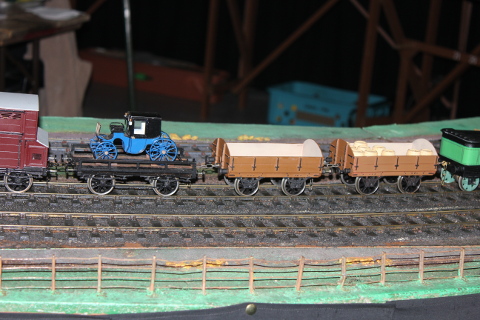
Two open wagons depicted in SC Brees, 'Railway Practice', c. 1838 lead a Great Northern Railway carriage truck from 1849. The vehicle is a 'Brougham', based on a surviving example in Cedar City, Utah. This carriage truck is standing in for an authentic London & Birmingham version which is presently in preparation.
The open trucks are printed in SLS nylon and the carriage truck is made in etched brass from a design in DK Clark's 'Railway Machinery', published in 1855. Note that the open wagons have dumb buffers at one end, and sprung examples at the other, a common practice on early railways.
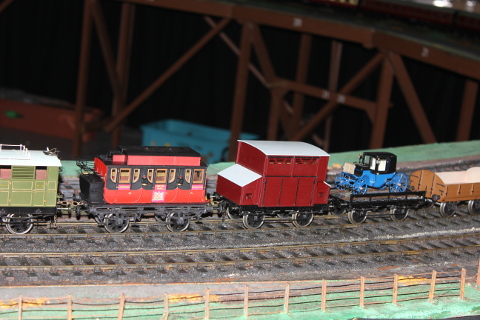
A further view of Harvey Combe's train with a very distinctive Great Northern horsebox leading a London & Birmingham mail coach. The horsebox is another design appearing in Clark's 'Railway Machinery' and was thought for a long time to be hypothetical, until a photograph emerged of two of them at Folkstone on the SECR in the 1870's. So they did exist, after all! It's rare to find photographs of early vehicles because the rate of progress condemned most of them to the scrap yard before the camera came into common use.
Following the horsebox is the L&BR mail coach, described by Francis Wishaw in 'railways of Great Britain and Ireland' published in 1840. This vehicle is similar to the 'Queen Adelaide' royal coach surviving in the National Railway Museum in York. The Post Office guard apears to have abandoned his post on the seat behind the roof box, which contained the mails and is called an 'Imperial' after stage coach practice. Just emerging behind the Mail is a london & Birmingham third, built in etched brass from a woodcut published in the Parliamentary report on 'Penny per Mile' travel in Hansard, 1844. Both coaches have etched brass bodies and the mail runs on a 3D printed underframe with authentic buffing gear visible inside the open solebars.