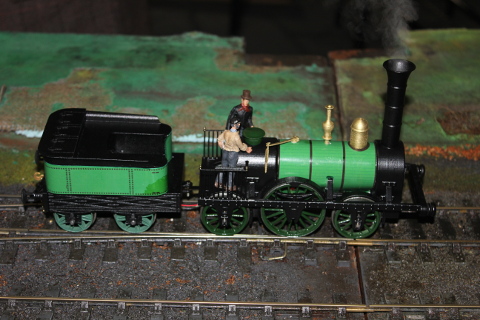
Stephenson's 'Patentee' Harvey Combe, 1835.
Built in 3D to 10mm/ft scale from drawings in Thomas Tredgold, Locomotive Engines, published by John Weale in 1850.
'Harvey Combe' was the name given to a locomotive originally built for a customer in Belgium but (according to Harry Jack in 'Locomotives of the LNWR Southern Division', RCTS, 2001) diverted to Cubitt & Co. who were building the Berkhampstead section of the London & Birmingham Railway in 1835. Tredgold's drawing are extremely detailed and are internally consistent, but appear to depict a locomotive slightly later than 'Harvey Combe' itself. This model has been slightly adapted to represent the engine as it appears in JC Bourne's famous engraving of the construction of Tring cutting in that year.
The model is printed in one piece in sintered (SLS) Nylon and powered by 3.7v Lipo battery with 2.4Ghz radio control, with a coreless motor in the tender driving through helical gears and Delrin chain transmission. Scale speed is a rather fast 30 mph and duration about 2 Hrs.
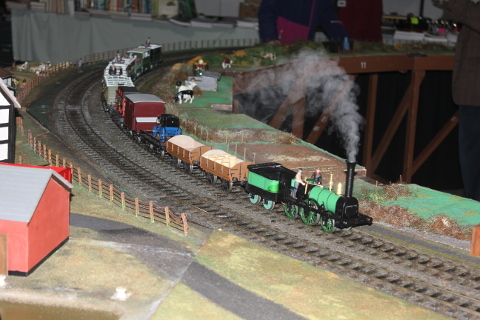
'Harvey Combe' in full cry with a representative train of 1840's stock, mostly drawn in 3D from contemporary engravings. The 'smoke effect' is generated by a piezo electric disk vibrating at 115 Khz which atomises, but does not evaporate, ordinary tap water. The disk is pierced by 70 holes each 7 microns in diameter which pump water from a reservoir into a high velocity stream as can be seen here.
It's not clear if 'Harvey Combe' ever actually ran on the completed railway as shown here, but another Bourne engraving shows it emerging from Primrose Hill tunnel with a similar train. It's possible that the choice of subject material in these engravings was influenced by the Stephenson's strong desire to have their locomotives, rather than those of Edward Bury, operate the new line.